TL;DR
- For planning only, a full-home replacement might be modeled at 4-8 weeks from contract to final inspection. This is an illustrative range, not a verified Jacksonville average or a completion commitment; some projects take longer.
- For planning only, allow an illustrative 1-3 days for on-site work on a straightforward project. Manufacturing, permitting, access, repairs, and scheduling can change both installation time and the total duration.
- A straightforward single-window installation might take half a day on site, while a custom whole-home project might use an 8-12-week planning allowance overall. These are examples, not guaranteed durations.
- Illustrative planning allowances: consultation (1-2 days), contract and order (same week), manufacturing (3-8 weeks), permit review (variable and sometimes parallel), installation (1-3 days), inspection (locally scheduled). Confirm each allowance for your project.
- Knowing the real timeline upfront prevents the "why is this taking so long?" frustration that comes from companies that quoted faster timelines they couldn't deliver.
"How long does this take?" is the second question most homeowners ask once they decide to replace windows. The first is how much it costs.
Both questions have honest answers and overselling answers. This post gives you the honest version—broken down by project type, by phase, and by the specific factors that move the timeline in either direction.
The Short Answer
For an illustrative full-home planning scenario, rather than a verified local average:
- Contract signing to final inspection: an example allowance of 4-8 weeks, potentially longer
- On-site installation: an example allowance of 1-3 days, subject to scope and conditions
- Projects may exceed 8 weeks because of product availability, permitting, repairs, weather, or scheduling.
These are planning examples, not minimum or maximum durations. A shorter quote is not by itself evidence of shortcuts or poor quality; ask how product availability, permits, crew capacity, and inspections support the proposed dates.
Let's walk through where the time goes.
Phase-by-Phase Breakdown
Phase 1: Consultation and Estimate (schedule varies)
The contractor visits, measures, discusses goals, and prepares an estimate. A 1-3-business-day estimate turnaround is a planning example, not an industry standard; confirm the appointment and written-quote schedule directly.
If the consultation includes high-pressure same-day signing or "today only" pricing, that's a flag worth pausing on — the legitimate timeline allows you to compare estimates from multiple companies.
Phase 2: Contract Signing (same week as decision)
After choosing a contractor, confirm the signing schedule and cancellation terms. Florida’s three-business-day cancellation right applies to qualifying home-solicitation sales, not automatically to every home-improvement contract. Obtain the applicable notice and instructions before signing.
Confirm the deposit and payment milestones in writing; a 25-50% deposit is an example to discuss, not a verified norm or a legal safe harbor.
Phase 3: Manufacturing Lead Time (illustrative allowances)
Manufacturing may be a major schedule driver. The following ranges are planning examples, not current manufacturer quotations:
Standard double-hung vinyl windows: an illustrative 3-5-week order-to-delivery allowance. Actual timing depends on stock, configuration, factory capacity, and shipping.
Custom sizes: an illustrative 4-6-week allowance. Customization may add time, but a fixed 1-2-week increment cannot be assumed.
Specialty or impact-rated products: an illustrative 6-10-week allowance, potentially longer. Obtain a current quote for the specific glass, shape, finish, and hardware.
Seasonal demand and storm-related ordering can affect availability. No verified statewide data is supplied here to quantify a May-August lead-time increase; ask the factory or contractor about current conditions.
Plan product selection and ordering around your desired completion date. DOE guidance can inform window selection and installation, but it does not establish the manufacturing lead-time ranges used in these examples. Related technical guidance.
A reputable contractor gives you an honest manufacturing estimate at order time and updates you if anything changes. A contractor who commits to delivery dates that consistently slip is signaling project management issues that may also affect other phases.
Phase 4: Permit Processing (timing varies; may overlap manufacturing)
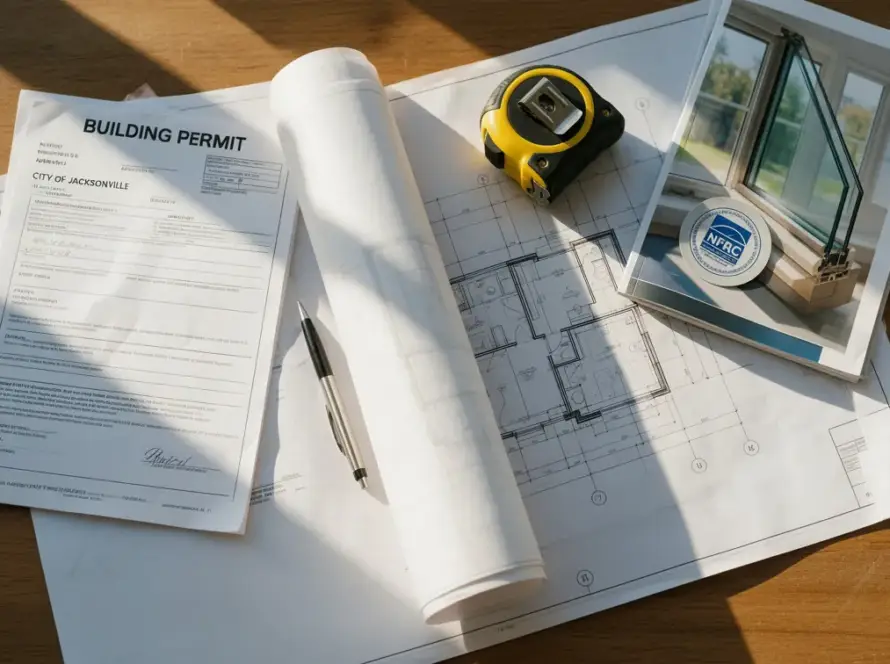
Confirm the required permit and review process with the building department serving the address. Permit review may overlap manufacturing, but do not assume a 1-3-week turnaround. Jacksonville’s general FAQ currently advises 25-30 business days for a first building-permit review; that is not a window-specific quote. Obtain a current project-specific estimate.
Permits are issued by:
- City of Jacksonville / Duval County — most Jacksonville-area projects
- Clay, St. Johns, Nassau, Putnam, Flagler Counties — projects outside Duval County
Permit processing can extend in cases of:
- Incomplete applications requiring revisions
- Reviews flagging code compliance questions
- Peak demand periods at the building department
- Specialty installations requiring additional engineering documentation
Permits and inspections address applicable code and approved-plan requirements. Design wind pressures depend on the site, exposure, building, and product—not just the county. Ask the contractor and building department what engineering and product approvals the project needs. Related technical guidance.
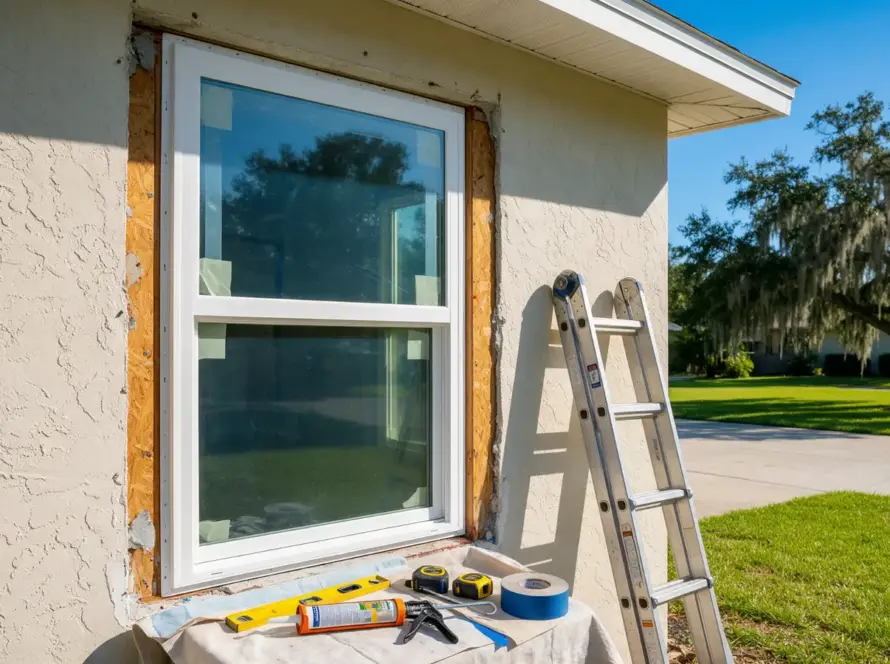
Phase 5: Installation (illustrative 1-3-day allowance)
After product delivery and required permit approval, installation can be scheduled. The following are illustrative crew-planning examples, not production guarantees:
Illustrative half-day allowance: 1-2 straightforward window replacements
Illustrative full-day allowance: 4-6 windows with simple access and no repairs
Illustrative two-day allowance: 8-12 windows
Illustrative three-day allowance: 12-18 windows, depending on preparation and access
Illustrative four-to-five-day allowance: 20+ windows or complex work; substantial repairs can take longer
Factors that extend installation time:
- Wood rot or water damage discovered after removing existing windows (requires repair before new windows are installed)
- Custom trim work or matching to existing architectural details
- Multi-story homes requiring scaffolding or specialty access
- Custom sizing requiring on-site adjustments
A good crew identifies unexpected conditions, makes the openings safe, and communicates any needed repair, price change, or schedule adjustment. Stopping for concealed damage is not by itself evidence of inexperience.
Phase 6: Inspection and Closeout (local scheduling varies)
After installation, the contractor schedules a final inspection with the building department. The inspector visits, verifies the installation meets code, and signs off on the permit.
Confirm inspection availability directly with the department serving your address; the following are not verified agency service commitments:
- City of Jacksonville: ask for the current inspection appointment window
- Other Duval County addresses: confirm the actual permitting authority and inspection schedule
- Surrounding counties and municipalities: confirm jurisdiction, inspection stages, and availability
Verify that all required inspections have passed and the permit is actually closed. Final payment timing is governed by the contract and applicable law; inspection sign-off alone does not determine every payment obligation.
Why the Long Timeline Matters
The illustrative 4-8-week allowance helps organize planning, but should not replace a current project schedule. Three considerations matter more than chasing a particular advertised duration:
Confirm whether the selected windows are in stock or made to order and obtain the delivery estimate. A short turnaround does not by itself imply poor quality or skipped steps; a stock product may be suitable if its dimensions and performance meet the project requirements.
Do not skip a required permit. Unpermitted work can lead to enforcement, corrective work, and complications during a sale. It does not automatically void most manufacturer warranties; coverage depends on lawful terms and the cause of the claimed damage. Verify any claimed exemption with the building department.
Keep inspection records as part of the project file. They document the compliance review and may help resolve an installation dispute, but are not a universal prerequisite to every manufacturer warranty claim.
For a deeper walkthrough of each phase, our companion post on the full window replacement process in Jacksonville covers what to expect step-by-step.
How to Speed Up the Timeline (Realistically)
There are legitimate ways to compress the timeline without skipping critical steps:
Start early if completion before summer or another deadline matters. Ask for current manufacturing, permit, and crew availability rather than assuming February or March always has shorter queues.
Compare current availability of suitable standard and custom products. A standard configuration may arrive sooner, but do not assume a 1-3-week saving or alter an opening without considering code, structural, and installation requirements.
Ask about current demand for impact-rated and specialty products. Winter or early-spring ordering may help in some cases, but a fixed seasonal advantage is not established here.
Ask who installs the windows and who is accountable for scheduling, quality, and warranty service. In-house crews and subcontracted crews can both be well managed; staffing model alone does not guarantee a shorter timeline.
Have everything ready for installation day. Move furniture away from windows, secure pets, and confirm access to each window the crew will work on. A crew that loses time to access issues stretches a one-day job into a two-day job.
What you should not do to speed things up: skip permits, accept a contractor who promises wildly faster timelines than industry norms, or pay upfront for "express" service that may not actually deliver faster results.
Seasonal Considerations in Jacksonville
Seasonal factors to discuss with your contractor—not verified monthly demand or turnaround statistics:
January-March: ask about factory and permit-office queues; cooler weather may help working conditions, but faster service is not guaranteed.
April-May: ask whether spring orders have changed availability for the selected products.
June-August: heat, thunderstorms, and tropical weather can affect safe working conditions. Confirm contingency plans rather than assuming every supplier or department is at peak capacity.
September-November: storm activity and repair demand may affect availability; conditions vary by year.
December: confirm factory, contractor, and building-department holiday closures before setting dates.
Choose dates using current supplier, contractor, and jurisdiction information rather than assuming particular months produce the smoothest project.
How Lifetime Windows Manages Project Timelines
For planning discussions, a 5-7-week contract-to-closeout scenario with 1-3 days on site may be useful, but it is not a guaranteed schedule. Confirm a written project-specific estimate based on the products, permits, and site conditions.
Scheduling expectations to confirm for your project:
- Honest manufacturing lead time based on the specific products you've chosen and current factory schedules
- A target permit-application date after the required project documents are ready
- Installation scheduling as soon as both windows and permit are ready
- Communication if anything changes the timeline (manufacturing delays, permit revisions, weather)
We use in-house licensed installation crews — not subcontractors — and the warranty terms we offer cover both the manufacturer warranty and our workmanship warranty in writing.
If you're trying to align a project with a specific deadline (before summer cooling load, before listing the home, before a family event), the right time to start the consultation is several weeks before you think you need to. To schedule a consultation or discuss financing options, reach out and we'll start the conversation.
For comparing window companies generally, our companion post on questions to ask a window installer in Jacksonville covers the broader evaluation framework before timeline becomes the focus.
Frequently Asked Questions
Can a window replacement really be completed in one day? A small, straightforward installation may fit into one on-site day; some larger projects may also do so with suitable staffing and conditions. The example 1-3-day installation and 4-8-week overall allowances in this article are planning scenarios, not rules. A one-day installation quote alone does not establish that permitting, custom sizing, or inspections were skipped.
What's the fastest realistic timeline from "I want to start" to "the project is done"? There is no universal minimum. Confirm stock or manufacturing availability, required permit approval, crew scheduling, and inspections. One illustrative schedule orders in Week 1 and installs and closes out around Weeks 5-6 if all dependencies align; this is not a guaranteed 4-5-week completion or proof that faster work requires shortcuts.
Why does manufacturing take so long for windows? Some products are stocked, while others are made to order for selected dimensions, glass, hardware, and finishes. Production, quality checks, shipping, and current capacity affect delivery. The 3-8-week allowance here is an example, not a verified production standard; specialty orders may take longer.
Does the time of year affect how long my project takes? It can. Weather, storm-related demand, factory capacity, and holidays can change scheduling. This article does not establish that Jacksonville’s industry runs at capacity in particular months or that winter guarantees shorter lead times. Ask for current project-specific estimates.
What happens if my installation runs longer than planned? Discovery of underlying issues — wood rot, water damage, code violations from previous work — can extend installation timelines. A reputable contractor handles these issues, communicates clearly with you about scope changes, and adjusts the timeline transparently. A contractor that simply extends the project without explanation or doesn't return to finish is a more serious issue worth flagging.
Can I be in my home during installation? Often, but agree on access and safety arrangements with the crew lead. Keep occupants, children, and pets away from active work and temporarily open windows. The time each opening remains exposed depends on the work and any hidden damage; do not assume every window will be completed within a few hours.
Want a realistic timeline for your specific Jacksonville window replacement project? Contact Lifetime Windows and we'll walk through what's actually achievable given your goals and current factory schedules.